
CASE STUDY ✦ AI INTEGRATION & WORKFLOW AUTOMATION
Beyond the Chatbot: Building a Personal AI Operating System
One connected ecosystem. Multiple workflows. A smarter way to work.
What happens when AI stops being something you occasionally ask questions and starts becoming a practical part of how you manage your work?
Using a combination of AI assistants, automation platforms, and existing business applications, I began building a connected system to support daily operations, communication, business development, content production, and decision-making.
The goal wasn't to automate everything. It was to identify where technology could meaningfully reduce repetitive work while preserving the creativity, judgment, and personal connections that matter.
Project Snapshot
Category
AI Integration & Workflow Automation
Project
Founder-Led Internal AI Pilot
Date
November 2026
The Challenge
Running a business while balancing leadership responsibilities, creative projects, content production, and professional development means managing a lot of moving pieces.
Emails live in one system, appointments in another; leads need tracking, content needs coordination, and projects and deadlines compete for attention — creating repetitive tasks, unnecessary handoffs, and information scattered across platforms.
The challenge was to create a more coordinated approach, without unnecessary complexity or replacing human decision-making.
The Solution
Rather than relying on one chatbot to do everything, I designed a complementary ecosystem of tools, each supporting a specific part of the workflow.
Some support thinking and planning, others manage communication and scheduling, and still others connect systems and move information where it needs to go.
The Technology Ecosystem
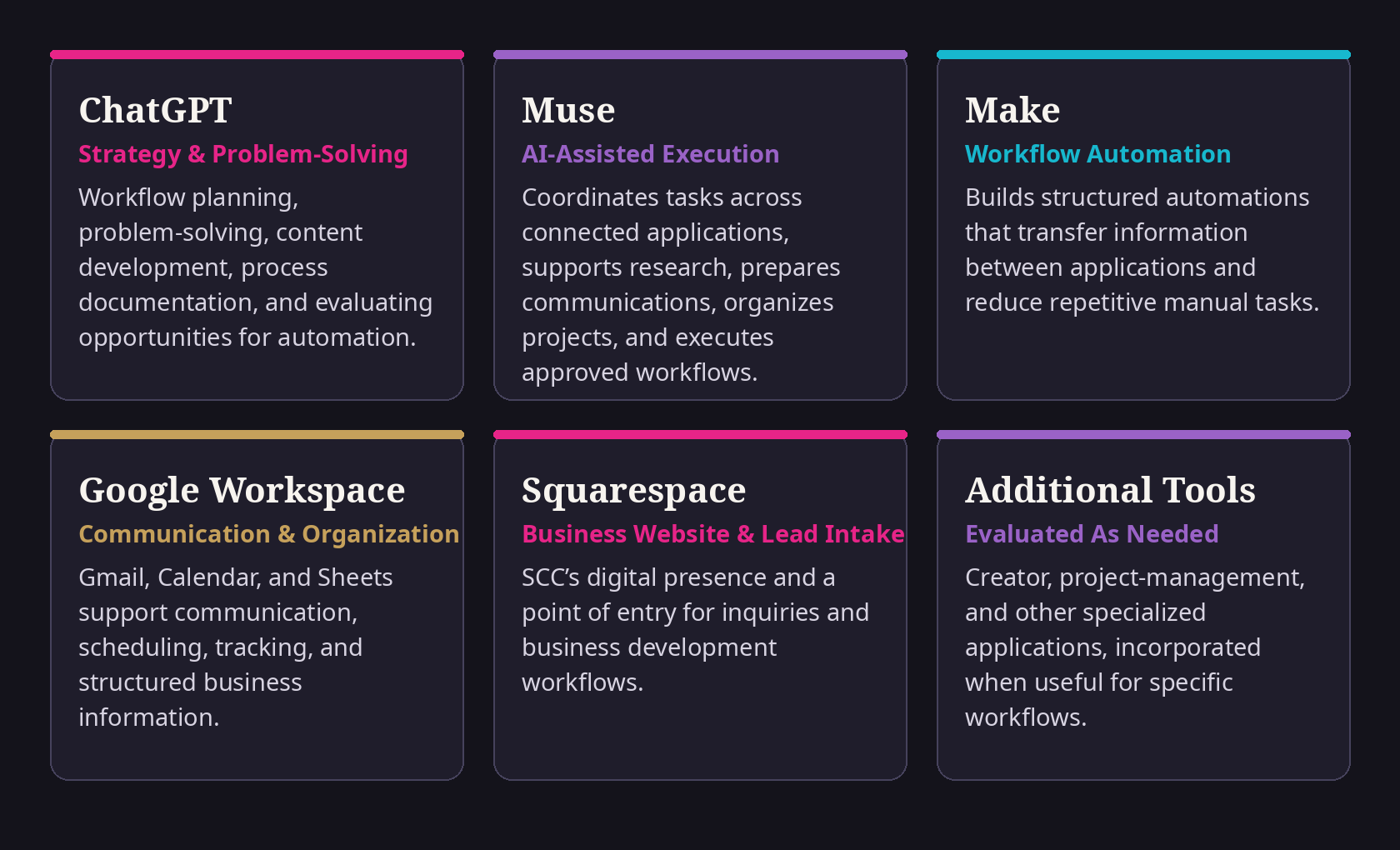
The technology should adapt to the workflow, not the other way around.
Workflow Applications
01. Email & Calendar Coordination — AI-assisted tools help organize communication, prepare responses, coordinate scheduling, and reduce the effort involved in managing multiple commitments. The focus is on improving responsiveness and organization while keeping important communications under human review.
02. Business Development & Lead Management — A structured lead-management automation was developed to connect website inquiries with a centralized tracking system. The workflow uses Squarespace, Make, Google Sheets, and Gmail to support inquiry capture, duplicate prevention, lead organization, and personalized draft responses. This provides a practical example of how independent business applications can work together.
03. Content & Creator Operations — AI-assisted planning supports content development, guest coordination, scheduling, follow-up preparation, and organization across a multi-platform creator workflow. Rather than replacing the creative process, the tools help organize the operational work around it.
04. Career & Opportunity Management — AI-assisted research, opportunity tracking, document preparation, and workflow coordination were explored and tested as part of the broader system. This demonstrates how automation principles can support complex processes involving multiple steps, records, and decisions.
05. Website & Digital Operations — AI-assisted website management supports the refinement of page layouts, messaging, navigation, and service positioning within Squarespace. The website itself becomes an example of combining AI-assisted execution with human creative direction and review.
06. Broader Administrative & Decision Support — Additional workflow opportunities explored include financial information organization, travel planning, proactive monitoring, and cross-application task coordination. These areas form part of the system's ongoing evaluation and are not presented as fully deployed or independently validated automations.
Featured Workflow: Automated Lead Management
One of the clearest examples of implementation is SCC's automated inquiry-management workflow.
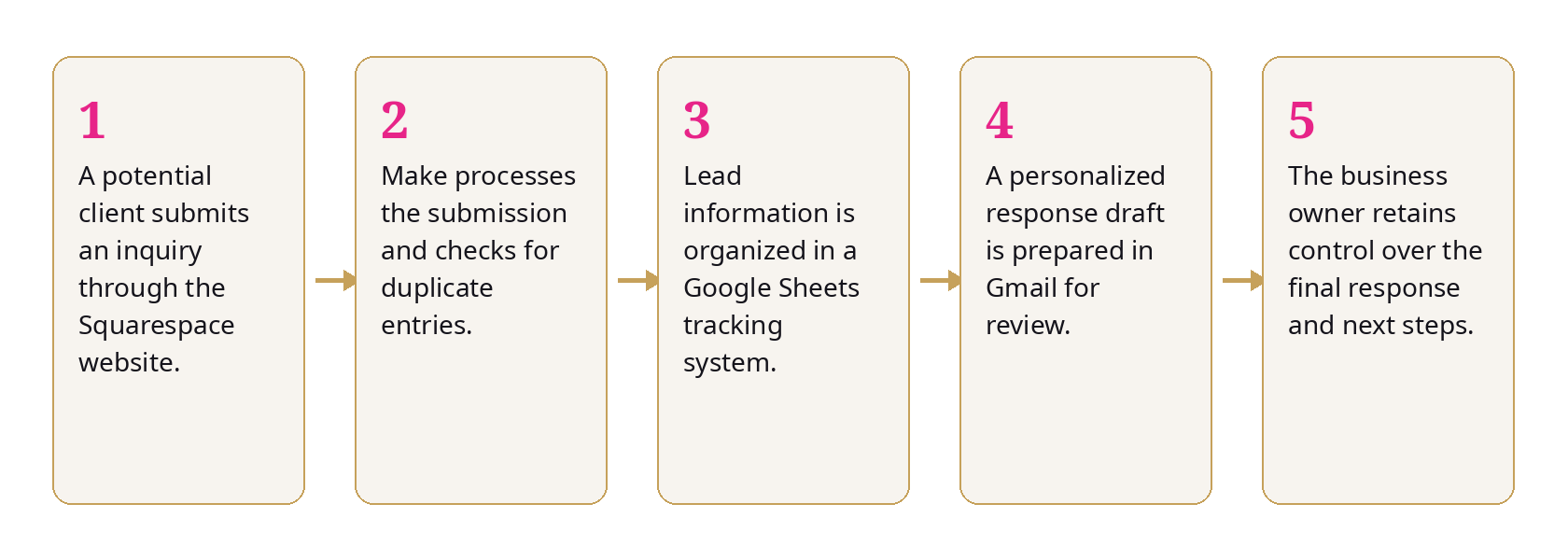
This workflow demonstrates how tools a small business may already use can be connected into a more coordinated process.
It also shows that useful automation does not always require expensive software or a complicated custom application.
The Approach
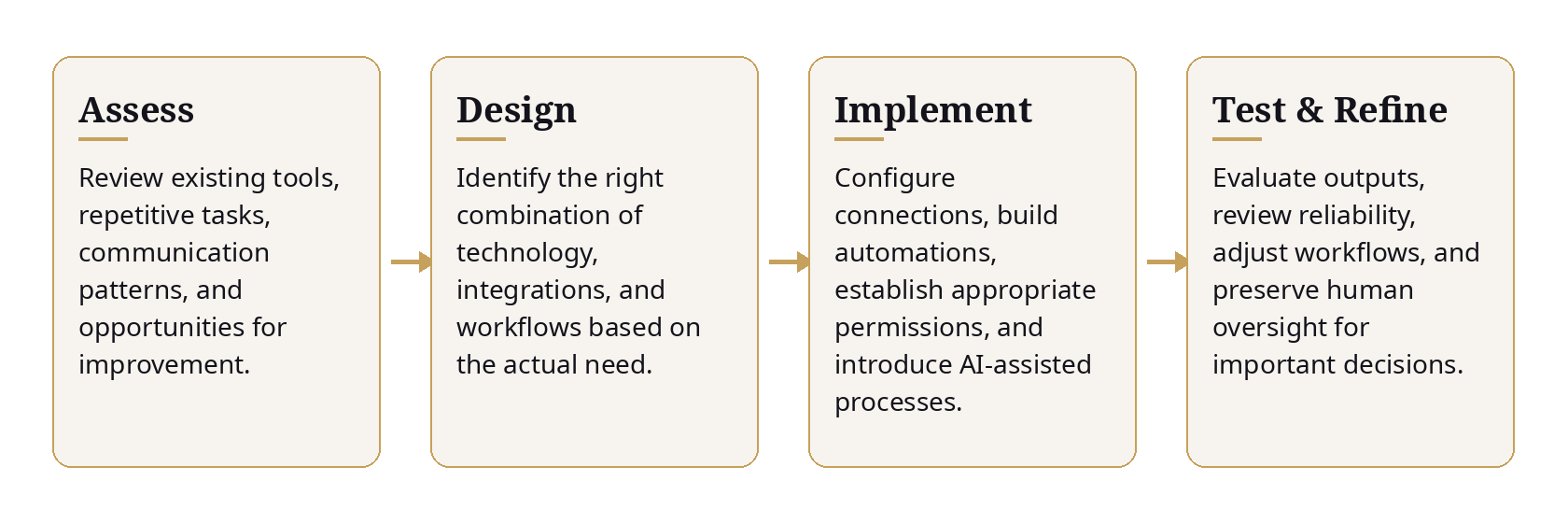
The Outcome
This ongoing pilot has demonstrated the feasibility of coordinating several AI and automation tools within a practical operating model.
The work has produced functioning automation components, AI-assisted processes, and a repeatable approach to evaluating where connected technology provides meaningful value.
It has also reinforced an important lesson: not every task should be automated, and not every business needs the same tools.
This is a founder-led internal pilot and ongoing implementation, not a paid client engagement. Time savings, revenue impact, and other performance improvements have not been independently quantified.
What This Means for Your Business
Your business doesn't need more disconnected software. It needs systems that work together.
Whether you're managing inquiries, coordinating scheduling, following up with customers, organizing internal operations, or trying to eliminate repetitive administrative tasks, the right combination of AI and automation can create a more connected workflow.
At Shari Creative Collective, I help businesses move beyond simply using AI tools toward implementing practical, sustainable solutions.
Your workflow. Your tools. A smarter way to work.
Free, No Pressure